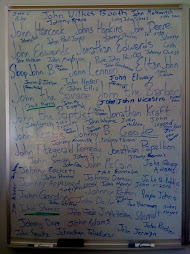
Choose one novel. In the comment box tell me which book your plan to read
Brave New World by Aldous Huxley*
1984 by George Orwell *
Handmaid's Tale by Margaret Atwood+
Player Piano by Kurt Vonnegut*
Oryx and Crake by Margaret Atwood+
We by Yevgeny Zemyatin~
Fahrenheit 451 by Ray Bradbury+
* I have many copies of these books.
+ These books are in the GHS library and Sawyer Free
~ This book is in Sawyer Free
Tuesday, February 10, 2009

Wednesday, January 14, 2009
Grendel Vocabulary
Sycophant A servile self-seeker who attempts to win favor by flattering influential people.
Noun Greek
Fuliginous Colored as if by soot
Adjective Latin
Hex An evil spell; a curse. To curse
Noun/Verb German
Leer desirous, sly, or knowing look. To glance sidelong esp. sexually or maliciously
Noun/verb Old English
Moor A broad area of open land, often high but poorly drained, with patches of heath and peat bogs.
Noun Old English
Solipsist One who believes in the theory or view that the self is the only reality.
Noun latin
Ominous Menacing; threatening
Adj latin
Undulant wave-like
Adj latin
Debauch To corrupt morally.
Verb french/germanic
Omniscience the state of being all knowing
Noun latin
Hoary Gray or white with or as if with age.
Noun Old English
Dirge A funeral hymn or lament.
Noun Latin
Dogmatism Arrogant, stubborn assertion of opinion or belief.
Noun greek
Petulant Unreasonably irritable or ill-tempered; peevish.
Adj latin
Intimation A hint; an obscure or indirect suggestion or notice; a remote or ambiguous reference; as, he had given only intimations of his design.
Noun latin
Nihilism A doctrine holding that all values are baseless and that nothing can be known or communicated
Noun latin
Paradox A seemingly contradictory statement that may nonetheless be true
Noun Greek
Inchoate In an initial or early stage; incipient.
Adj latin
Ossify To change into bone; become bony. To become rigid
Verb latin
Omnipotence unlimited or universal power
Noun latin
Noun Greek
Fuliginous Colored as if by soot
Adjective Latin
Hex An evil spell; a curse. To curse
Noun/Verb German
Leer desirous, sly, or knowing look. To glance sidelong esp. sexually or maliciously
Noun/verb Old English
Moor A broad area of open land, often high but poorly drained, with patches of heath and peat bogs.
Noun Old English
Solipsist One who believes in the theory or view that the self is the only reality.
Noun latin
Ominous Menacing; threatening
Adj latin
Undulant wave-like
Adj latin
Debauch To corrupt morally.
Verb french/germanic
Omniscience the state of being all knowing
Noun latin
Hoary Gray or white with or as if with age.
Noun Old English
Dirge A funeral hymn or lament.
Noun Latin
Dogmatism Arrogant, stubborn assertion of opinion or belief.
Noun greek
Petulant Unreasonably irritable or ill-tempered; peevish.
Adj latin
Intimation A hint; an obscure or indirect suggestion or notice; a remote or ambiguous reference; as, he had given only intimations of his design.
Noun latin
Nihilism A doctrine holding that all values are baseless and that nothing can be known or communicated
Noun latin
Paradox A seemingly contradictory statement that may nonetheless be true
Noun Greek
Inchoate In an initial or early stage; incipient.
Adj latin
Ossify To change into bone; become bony. To become rigid
Verb latin
Omnipotence unlimited or universal power
Noun latin
Beowulf Vocabulary Words
Beowulf Vocabulary
af•flic•tion
n. A condition of pain, suffering, or distress; A cause of pain, suffering, or distress.
—Synonyms 2. mishap, trouble, tribulation, calamity, catastrophe, disaster. Affliction, adversity, misfortune, trial refer to an event or circumstance that is hard to bear.
—Antonyms 1. relief, comfort, solace.
[Origin: 1300–50; ME affliccioun < L afflīctiōn- (s. of afflīctiō).]
al•lit•er•a•tion
n. The repetition of the same sounds or of the same kinds of sounds at the beginning of words or in stressed syllables, as in “on scrolls of silver snowy sentences” (Hart Crane). Modern alliteration is predominantly consonantal; certain literary traditions, such as Old English verse, also alliterate using vowel sounds.
[From ad- + Latin littera, letter.]
cae•su•ra also ce•su•ra
n. Prosody. a break, esp. a sense pause, usually near the middle of a verse, and marked in scansion by a double vertical line
A pause or interruption, as in conversation
[Latin caes ra, a cutting, from caesus, past participle of caedere, to cut off. See ka -id- in Indo-European Roots.]
ep•ic
n. An extended narrative poem in elevated or dignified language, celebrating the feats of a legendary or traditional hero (or any literary work, period of history, etc. resembling an epic)
adj. Related to a literary epic; Surpassing the usual or ordinary, particularly in scope or size; Heroic and impressive
ken•ning
n. A figurative, usually compound expression used in place of a name or noun, especially in Old English and Old Norse poetry; for example, storm of swords is a kenning for battle and wave traveler is a kenning for boat.
[Old Norse, from kenna, to know, to name with a kenning. See gn - in Indo-European Roots.]
mail n. Flexible armor composed of small overlapping metal rings, loops of chain, or scales. 2. The protective covering of certain animals, as the shell of a turtle.
[Middle English, from Old French maile, from Latin macula, blemish, mesh.]
mead
n. An alcoholic beverage made from fermented honey and water.
scop
n. An Old English poet or bard.
[Old English.]
sen•ti•nel
n. One that keeps guard; a sentry (a guard, a watch, a lookout).
[Middle French, from Old Italian, from Latin]
sin•ew
n.
A tendon.
Vigorous strength; muscular power.
The source or mainstay of vitality and strength.
[Middle English, from Old English]
sol•ace
n. Comfort (or a source of comfort) in sorrow, misfortune, or distress; consolation; alleviation; relief.
[Middle English, from Old French, from Latin]
weird
adj.
Of, relating to, or suggestive of the preternatural or supernatural.
Of a strikingly odd or unusual character; strange.
Archaic Of or relating to fate or the Fates.
n.
Fate; destiny.
[Middle English from Old English wyrd, fate]
af•flic•tion
n. A condition of pain, suffering, or distress; A cause of pain, suffering, or distress.
—Synonyms 2. mishap, trouble, tribulation, calamity, catastrophe, disaster. Affliction, adversity, misfortune, trial refer to an event or circumstance that is hard to bear.
—Antonyms 1. relief, comfort, solace.
[Origin: 1300–50; ME affliccioun < L afflīctiōn- (s. of afflīctiō).]
al•lit•er•a•tion
n. The repetition of the same sounds or of the same kinds of sounds at the beginning of words or in stressed syllables, as in “on scrolls of silver snowy sentences” (Hart Crane). Modern alliteration is predominantly consonantal; certain literary traditions, such as Old English verse, also alliterate using vowel sounds.
[From ad- + Latin littera, letter.]
cae•su•ra also ce•su•ra
n. Prosody. a break, esp. a sense pause, usually near the middle of a verse, and marked in scansion by a double vertical line
A pause or interruption, as in conversation
[Latin caes ra, a cutting, from caesus, past participle of caedere, to cut off. See ka -id- in Indo-European Roots.]
ep•ic
n. An extended narrative poem in elevated or dignified language, celebrating the feats of a legendary or traditional hero (or any literary work, period of history, etc. resembling an epic)
adj. Related to a literary epic; Surpassing the usual or ordinary, particularly in scope or size; Heroic and impressive
ken•ning
n. A figurative, usually compound expression used in place of a name or noun, especially in Old English and Old Norse poetry; for example, storm of swords is a kenning for battle and wave traveler is a kenning for boat.
[Old Norse, from kenna, to know, to name with a kenning. See gn - in Indo-European Roots.]
mail n. Flexible armor composed of small overlapping metal rings, loops of chain, or scales. 2. The protective covering of certain animals, as the shell of a turtle.
[Middle English, from Old French maile, from Latin macula, blemish, mesh.]
mead
n. An alcoholic beverage made from fermented honey and water.
scop
n. An Old English poet or bard.
[Old English.]
sen•ti•nel
n. One that keeps guard; a sentry (a guard, a watch, a lookout).
[Middle French, from Old Italian, from Latin]
sin•ew
n.
A tendon.
Vigorous strength; muscular power.
The source or mainstay of vitality and strength.
[Middle English, from Old English]
sol•ace
n. Comfort (or a source of comfort) in sorrow, misfortune, or distress; consolation; alleviation; relief.
[Middle English, from Old French, from Latin]
weird
adj.
Of, relating to, or suggestive of the preternatural or supernatural.
Of a strikingly odd or unusual character; strange.
Archaic Of or relating to fate or the Fates.
n.
Fate; destiny.
[Middle English from Old English wyrd, fate]
Thursday, January 8, 2009
The Meeting in Chapter 5 of Lord of the Flies
In a paragraph explain the role of one character in the meeting depicted in chapter five. Make sure your paragraph consists of seven or more sentences. Be specific. Refer to exact words if possible. Consider the character's whole role--from the beginning of the chapter to the end. Also, make sure you consider the literal and symbolic meanings of the character's role in the meeting. Finally, if you're going to write about the littluns consider them all (Phil, Percival,...)
Monday, December 15, 2008
Reading Check on Chapters 1, 2, and 3 of Lord of the Flies
Guiding Questions for Chapters 1, 2, 3
Chapter 1: The Sound of the Shell
“They knew very well why he hadn’t: because of the enormity of the knife descending and cutting into living flesh; because of the unbearable blood.
‘I was going to,” said Jack. He was ahead of them and they could not see his face. “I was choosing a place. Next time--!”
He snatched his knife out of the sheath and slammed it into a tree trunk. Next time there would be no mercy.
1. What are is the narrator talking about here? (Hint: it relates to one of the motifs.)
Chapter 2: Fire on the Mountain
“You got your small fire alright.”
2. What is Piggy talking about here? How is the event Piggy is talking about significant in terms of William Golding’s opinion that “man suffers from an appalling ignorance of his own nature”? (Hint: this is related to the littlun with the mulberry-colored mark on his face.)
Chapter 3: Huts on the Beach
3. How does this chapter illustrate the conflict between Ralph and Jack’s priorities? (Hint: this is related to two different motifs.)
4. In chapter 3 Ralph asserts “This is our island. It’s a good island.” What motif is spoken about (but perhaps not literally present) in chapters two and three that undermines Ralph’s opinion?
Overall
5. Write about the significance of your character through the first three chapters of the book.
6. Write about the significance of your motif through the first three chapters of the book.
Tuesday, December 9, 2008
Dracula by Bram Stoker
 Monster Book Comments #3 Due by midnight Wednesday 1/7
Three sections
* Label your response to this section 3a
Briefly explain any changes in the monsters, beast, or demon since your first comment. How are the changes in the monster, in the monster's experiences, or in the monster's situation significant? (A paragraph: 7+ sentences.) I'm not looking for plot summary; I'm looking for connections to and development of the monster theme. Along the way convince me that you understand how the monster's situation has developed since "Comments #2" which were due before the holiday break.
*Label your response to this section 3b
Respond to someone else's comment about the book. If no one else is reading your book then compare your thoughts about your monster to someone else's thoughts about the monster in her or his book. Write at least seven sentences.
*Label your response to this section 3c
Write another journal entry as if you were the monster of the book. Write in the monster's voice about the monster's experiences and situation. Convince me that you understand the monster's situation and feelings about the situation. Use at least three details from the last section you have read. Mark the details (1), (2), (3). Write at least seven sentences.
Monster Book Comments #2 Due by midnight Wednesday 12/11
Three sections
* Label your response to this section 2a
Briefly explain any changes in the monsters, beast, or demon since your first comment. How are the changes in the monster, in the monster's experiences, or in the monster's situation significant? (A paragraph: 7+ sentences.) I'm not looking for plot summary; I'm looking for connections to and development of the monster theme.
*Label your response to this section 2b
Respond to someone else's comment about the book. If no one else is reading your book then compare your thoughts about your monster to someone else's thoughts about the monster in her or his book. (A paragraph.)
*Label your response to this section 2c
Write a journal entry as if you were the monster of the book. Write in the monster's voice about the monster's experiences and situation. (A paragraph.)
Monster Book Comments #1 (300+ words) Due by midnight Wednesday (12/10)
Using the definitions of “monster,” “beast,” and/or “demon,” explore how the theme of monstrousness is developed over the first 100+ pages of the book you have been reading.
You might begin by showing how a character or entity fits a particular definition or set of definitions. But do not limit yourself to proving that so-and-so is a monster. Also, do not merely summarize all of the “monstrous” or “beastly” or “demonic” events in the book. That is plot summary. Instead, write an exploratory, explanatory, expository essay.
Show how the author explores ideas about monsters. Here are some possibilities:
- physical monstrousness can be used as a (false?) projection of man(un)kind’s internal monstrousness,
- external beauty (or success, or noble words, or other facades) can mask monstrosity,
- humanity’s inner nature can be seen as naturally and unavoidably “beastly,”
- our intellect (theory-making, pattern-making, meaning-making, civilization-building) can be seen as the source of monstrousness,
- fictional monsters can be interpreted as projections of human fears (about scientific or other progress, about our own inner desires, about nature’s senselessness, about the fragility of our existence, etc.),
- monsters can be used as a way of defining what is human (humane) and what is not-human (inhumane, beastly),
- overcoming monsters (or monstrousness) can be used as a way of defining human heroism, nobility, and even goodness,
- monsters (or monstrous behavior) can be used to explore the issue of nature (innate characteristics that humans are born with) versus nurture (learned behavior): is the monster born or made?,
- monsters can be used as a way to explore the effects of isolation, rejection, exclusion, etc.,
- monsters can be used as a way of exploring whether good and evil are absolute or whether they are only a matter of perception (Hamlet says, “nothing is good or bad but thinking makes it so,”
- and on and on and on…
Red Badge of Courage by Stephen Crane
 Monster Book Comments #3 Due by midnight Wednesday 1/7
Three sections
* Label your response to this section 3a
Briefly explain any changes in the monsters, beast, or demon since your first comment. How are the changes in the monster, in the monster's experiences, or in the monster's situation significant? (A paragraph: 7+ sentences.) I'm not looking for plot summary; I'm looking for connections to and development of the monster theme. Along the way convince me that you understand how the monster's situation has developed since "Comments #2" which were due before the holiday break.
*Label your response to this section 3b
Respond to someone else's comment about the book. If no one else is reading your book then compare your thoughts about your monster to someone else's thoughts about the monster in her or his book. Write at least seven sentences.
*Label your response to this section 3c
Write another journal entry as if you were the monster of the book. Write in the monster's voice about the monster's experiences and situation. Convince me that you understand the monster's situation and feelings about the situation. Use at least three details from the last section you have read. Mark the details (1), (2), (3). Write at least seven sentences.
Monster Book Comments #2 Due by midnight Wednesday 12/11
Three sections
* Label your response to this section 2a
Briefly explain any changes in the monsters, beast, or demon since your first comment. How are the changes in the monster, in the monster's experiences, or in the monster's situation significant? (A paragraph: 7+ sentences.) I'm not looking for plot summary; I'm looking for connections to and development of the monster theme.
*Label your response to this section 2b
Respond to someone else's comment about the book. If no one else is reading your book then compare your thoughts about your monster to someone else's thoughts about the monster in her or his book. (A paragraph.)
*Label your response to this section 2c
Write a journal entry as if you were the monster of the book. Write in the monster's voice about the monster's experiences and situation. (A paragraph.)
Monster Book Comments #1 (300+ words) Due by midnight Wednesday (12/10)
Using the definitions of “monster,” “beast,” and/or “demon,” explore how the theme of monstrousness is developed over the first 100+ pages of the book you have been reading.
You might begin by showing how a character or entity fits a particular definition or set of definitions. But do not limit yourself to proving that so-and-so is a monster. Also, do not merely summarize all of the “monstrous” or “beastly” or “demonic” events in the book. That is plot summary. Instead, write an exploratory, explanatory, expository essay.
Show how the author explores ideas about monsters. Here are some possibilities:
- physical monstrousness can be used as a (false?) projection of man(un)kind’s internal monstrousness,
- external beauty (or success, or noble words, or other facades) can mask monstrosity,
- humanity’s inner nature can be seen as naturally and unavoidably “beastly,”
- our intellect (theory-making, pattern-making, meaning-making, civilization-building) can be seen as the source of monstrousness,
- fictional monsters can be interpreted as projections of human fears (about scientific or other progress, about our own inner desires, about nature’s senselessness, about the fragility of our existence, etc.),
- monsters can be used as a way of defining what is human (humane) and what is not-human (inhumane, beastly),
- overcoming monsters (or monstrousness) can be used as a way of defining human heroism, nobility, and even goodness,
- monsters (or monstrous behavior) can be used to explore the issue of nature (innate characteristics that humans are born with) versus nurture (learned behavior): is the monster born or made?,
- monsters can be used as a way to explore the effects of isolation, rejection, exclusion, etc.,
- monsters can be used as a way of exploring whether good and evil are absolute or whether they are only a matter of perception (Hamlet says, “nothing is good or bad but thinking makes it so,”
- and on and on and on…
Subscribe to:
Posts (Atom)